On Saturday, 23 August 2025, the Ibadan Book and Arts Festival (IbaFest), in collaboration with NuStreams, held an evening of rare illumination at the NuStreams Conference and Culture Centre, Ibadan. Titled The Polymath’s Journey: A Conversation on Humanity, Technology, and the Yoruba Worldview, the gathering drew together lovers of literature, culture, and knowledge to celebrate the life and work of Dr Tunde Adegbola, scholar, technologist, teacher, cultural advocate, and musician. The event served as a celebration of the icon and also one of the headline pre-festival events for the inaugural Ibadan Book and Arts Festival, scheduled for 24–25 October 2025 at the University of Ibadan.
The mood for the event was set with a welcome speech by the celebrated Pastor Francis Madojemu, CEO of NuStreams, who encouraged everyone to participate in the event before handing over to the moderators, Olanike Onimisi and Kayode Sanni.
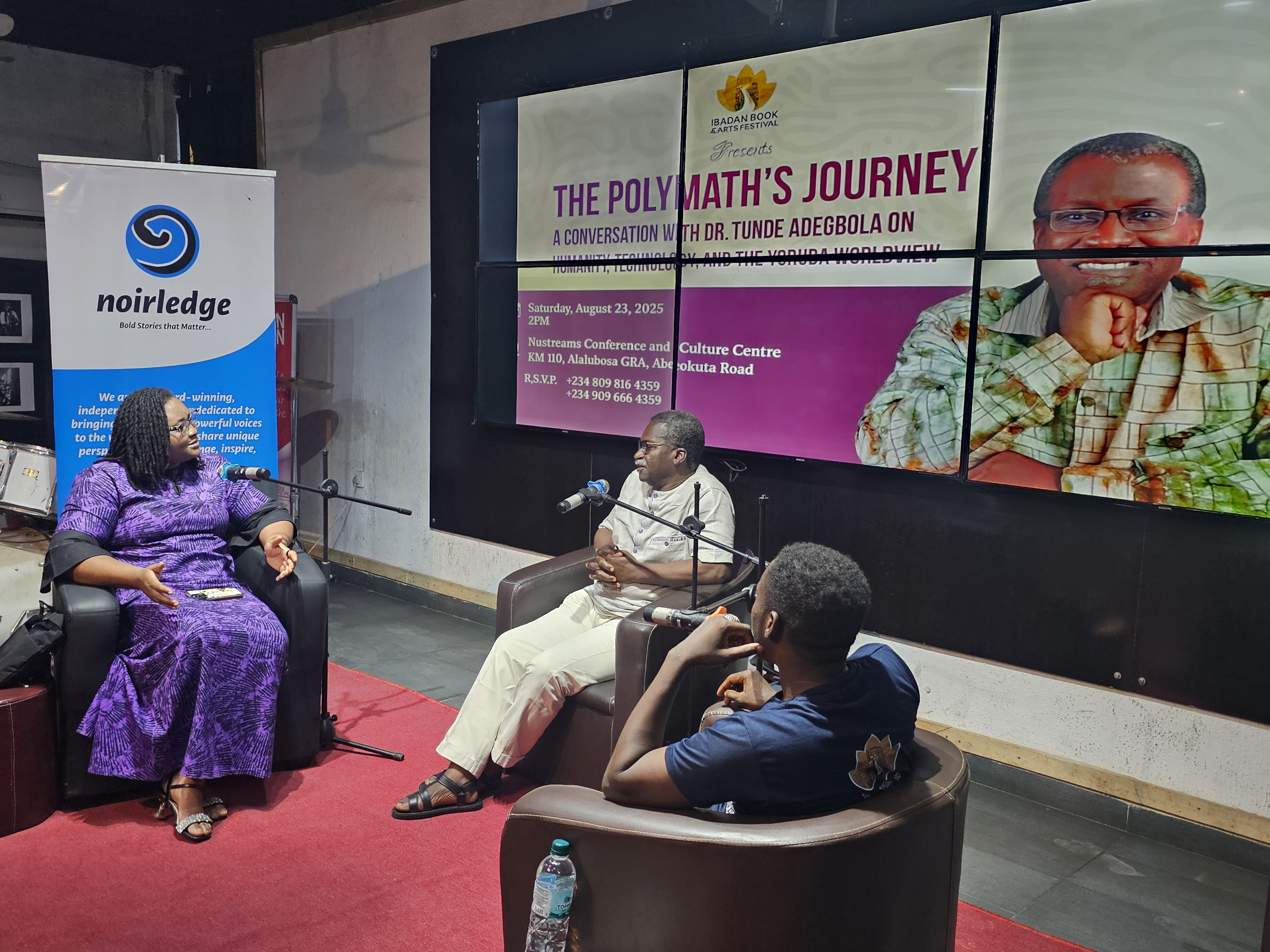
This was followed by a virtual exhibition of awards and artefacts that narrated Dr Adegbola’s decades of impact. Among them were plaques from Microsoft, recognition of his pioneering work at the Ogun State Broadcasting Corporation, and the Silent Achiever Award from the Change a Life Foundation, presented by former Lagos State governor Babatunde Raji Fashola. Yet, with characteristic modesty, he downplayed these honours, remarking with a smile that while it is reasonable to appreciate a lecturer, no one teacher should be declared “the best.” Interspersed with these awards were relics of early computing technologies and selections from his vast personal music archive, evidence of a passion that has been a constant companion. Indeed, as the evening unfolded, his love of sound would re-emerge, not only as a theme but as a performance.
Reflecting on life at seventy, Dr Adegbola spoke with candour about the health battles that had shaped his recent years, recalling a prostate cancer diagnosis at sixty and the period when he walked with a stick. Gratitude to God, rather than bitterness, defined his tone, as he gave thanks for being alive to mark this milestone.
I was diagnosed with prostate cancer at 60, which altered my body and mind. I walked with a stick for almost three years. Therefore, I give thanks to God for being alive to see this moment.
From this reflection, the discussion turned to education and language, subjects he has championed with conviction. He criticised the Federal Government’s reversal of its policy to educate young pupils in indigenous languages, insisting that no nation has ever attained greatness by discarding its mother tongue. If language underpinned the Industrial Age, he argued, it is even more indispensable in today’s Information Age, where the very fabric of knowledge is woven through words. Drawing from his own life, he recalled how arithmetic was first taught to him in Yoruba—idi and eyo, not tens and units—making mathematics not a foreign import but an intimate extension of language.
There is no record of any people who became great by adopting a foreign language. All the countries that taught in their language became industrial societies in the Industrial Age. […] We have moved from the Industrial Age into the Information Age, and language is the basis of information. No language, no information. If language played such a pivotal role in the Industrial Age, how much more in the Information Age?
As the dialogue progressed, Dr Adegbola reflected on the breadth of his own interests across science, technology, and the arts. He recalled being told as a teenager that he could not pursue both physics and music, but he refused such restrictions. Knowledge, in his view, is indivisible. This philosophy informed his reflections on Artificial Intelligence, where he urged students to embrace these tools as aids rather than crutches. AI, he warned, risks making learners intellectually complacent if used uncritically. True learning, he reminded the audience, is achieved through practice, experimentation, and the exercise of human intelligence.
Education, for him, remains the strongest lever of transformation. He lamented the gap between theory and practice in Nigeria’s institutions, noting that with his engineering degree he could not initially repair a simple radio until apprenticing informally. In his view, the obsession with publishing in foreign journals only deepens this disconnect, encouraging scholars to pursue international validation rather than producing research that addresses Nigeria’s realities. Such a pattern, he quipped, makes “charity begin abroad.”
The conversation then turned to indigenous systems of knowledge. Responding to poet and winner of the 2013 Nigeria Prize for Literature, Tade Ipadeola, Dr Adegbola described aroko as a powerful encryption system, perhaps as sophisticated as codes used during the Second World War. He reminded the audience that before the telephone, the Yoruba talking drum was the fastest means of long-distance communication, outpacing pigeons, horses, and human messengers, and that in the Americas, drums were used in slave camps to coordinate uprisings. On the subject of Ifa, he distinguished between religion and knowledge, explaining that while he remains an unapologetic Christian, he studies Ifa as a body of science, mathematics, and logic. Mystification, he explained, arises only when knowledge is severed from its roots, a condition worsened by centuries of slavery and colonialism, which removed generations of intellectuals from their societies and interrupted the transmission of wisdom. Yet even so, the surviving body of knowledge passed through orature remains a testament to the richness of the heritage.
Towards the close of the evening, Dr Adegbola spoke with openness about his future. Though grateful for what he has achieved, he confessed to one area where he feels he has not thrived: business. In 1985, he established the first microcomputer company in Ibadan, but he regards it as a venture where success eluded him. Nonetheless, his aspirations endure. He expressed hope that his health will sustain him to continue exploring new possibilities in language and knowledge.
The evening ended on a note of music, as Dr Adegbola took his place at the keyboard alongside his childhood friend, Anjola Aboderin, with whom he first began playing at the age of twelve. Their breathtaking performance was celebrated by everyone who marvelled at the harmony of their music, which in many ways reflected the harmony in many parts of Dr Adegbola’s polymathic life; science, technology, language, and music entwined in one enduring spirit.
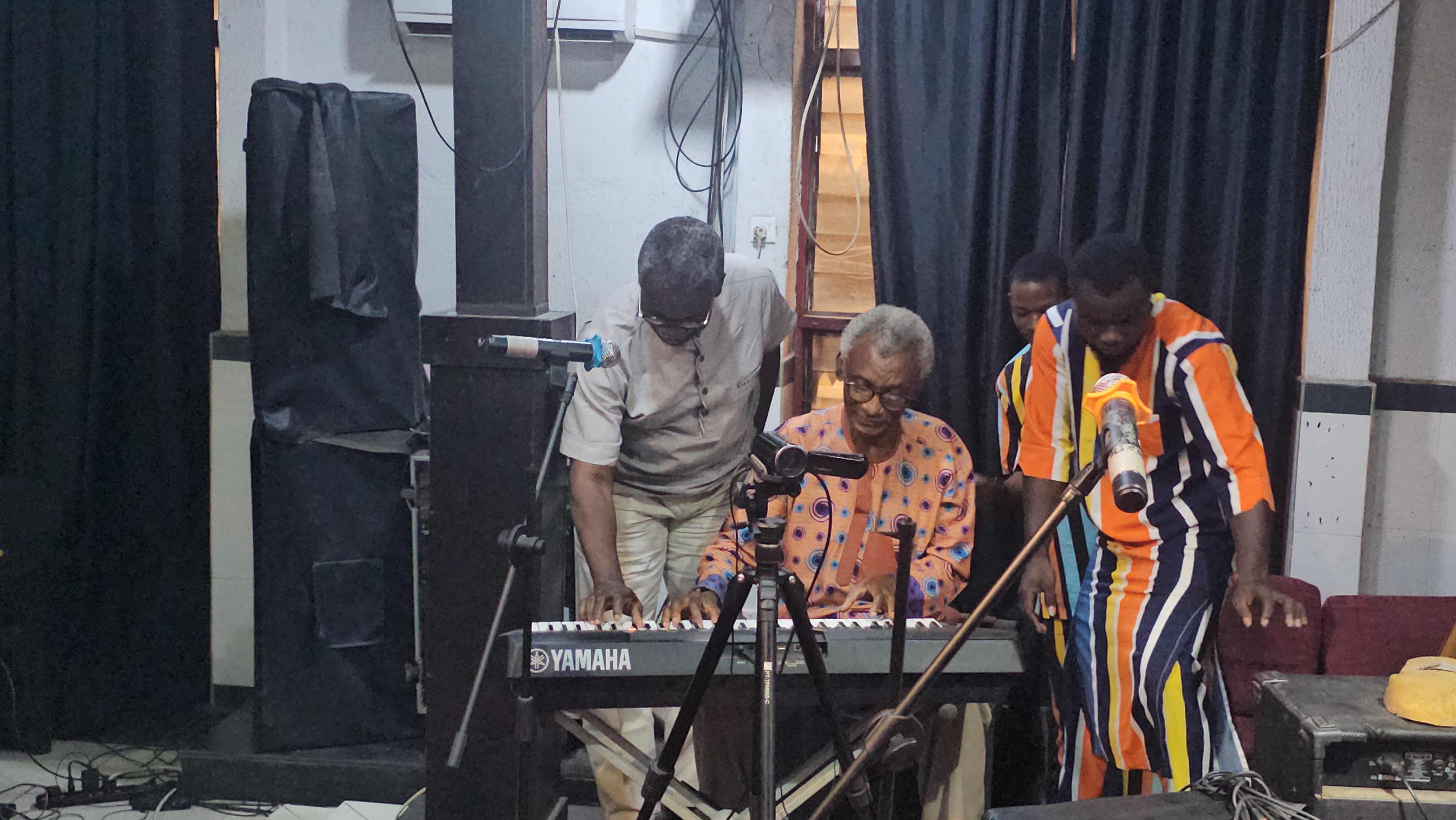
Closing the event, Festival Director and multiple award-winning poet, Servio Gbadamosi described the conversation as an inspiration and a reminder to never give up, recalling Professor Niyi Osundare’s charge at a previous IbaFest gathering: “Against all odds, keep hope alive.” With those words, he invited the public to the first Ibadan Book and Arts Festival in October, which will gather writers, artists, and thinkers from across Nigeria and beyond in celebration of a city that has long stood as a beacon of creativity and intellect.
What the evening ultimately revealed was not only the breadth of Dr Adegbola’s achievements, but the way they continue to speak to our collective future. It was a reminder that culture, language, and knowledge are inseparable threads, and that through voices like his, we are urged to preserve, reimagine, and carry forward the richness of our heritage into the world that awaits.
The Ibadan Book and Arts Festival continues with other pre-festival events leading to the full festival scheduled for October 24-25, 2025. The two-day festival, to be held at the International Conference Centre, University of Ibadan, will feature book readings, panel conversations, performances, an art exhibition, and a celebration of Ibadan’s rich literary and cultural heritage. It also coincides with a month-long multimedia exhibition honouring Dr Adegbola at 70.
 sevhage