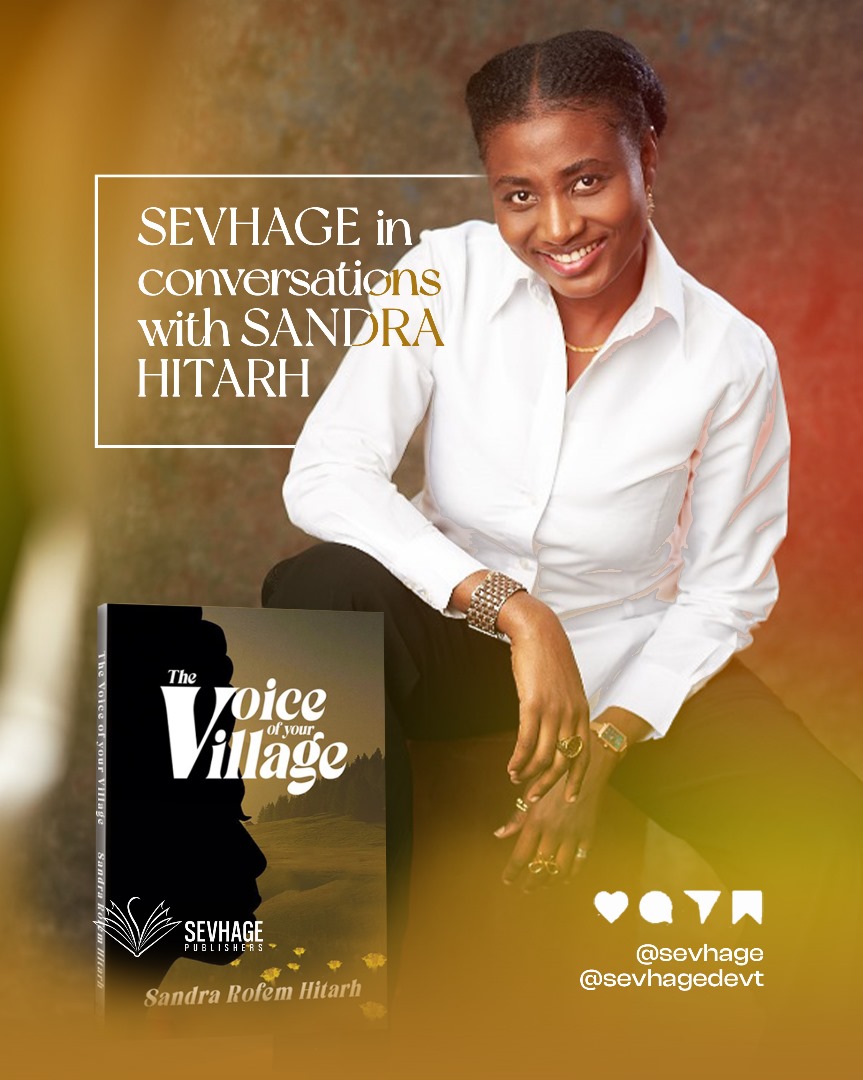
Join us for a conversation with our author, Sandra Hitarh, poet and officer, author of Voice of Your Village, with SEVHAGE lead, S. Su’eddie Vershima Agema. Graphics courtesy of Stephen Adakole.
What’s your writing history? When did you start writing, what were your influences and what’s your earliest memory of your writing?
Like a typical artist, I started my journey quite early. Pretty much about when I was eight years old. I have always been a scribbler. I was influenced by my environment; predominantly my experiences as a child where I lived, where my mom’s mother’s shop was, friends and classmates in school who would ask me to write poems to for their crush on special days.
Sandra, can you take us back to that afternoon in 2003 when you were first called ‘a poet’? What was the occasion, and how did that moment influence your journey as a writer?
Yes. Like I said I was a scribbler, but I did not think much of it and then on this certain day, I was 11 years old, my uncle Alfred, came visiting and he hailed ‘our poet! what have you written recently?’. I asked how he knew I wrote poems, and he told me I wrote one for him and that I’d always written in my school books. He quickly produced a poem I wrote for him and that was officially the time I recognized myself as a writer. So armed with this knowledge I wrote more deliberately and was no longer as careless as I was with my scribbled art. My work meant something; I had an audience, and somebody was listening.
As a military officer, poet, podcaster, and mental health advocate, how do you balance these diverse roles? Do they intersect in (un)expected ways in your poetry?
Balance has always been a key word for me. It is a reminder that I have so much to accomplish. It sure has been difficult to juggle between all these ventures but with the advent of social media, I try to play with available time, particularly at night and when distracted on formal occasions. And yes, they intersect. This is because poetry in itself does not come from the blues. It’s a form of expression and my encounters within the military space as well as the mental health and wellness space, have formed the conversations in my poetry and the language of the poetry. So, poetry becomes a strengthener for the soldier and a winner’s song for someone who broke free from the grasp of depression. Poetry is also a place to bare it all out until old pain is soaked in the pages of a paper.
As a follow-up question, how does your experience as a military officer shape your creative process and the themes you explore in your poetry? In essence, how does the discipline and structure of military life influence your creative process? Are there any specific instances where your military experiences directly inspired a poem?
I belong to the military habitat so my activities would Dean to a large extent to the military So what the military does for me is that it exposes me to the life of a soldier to explore their sacrifices witness it first hand and share with people who seemingly are not aware of the sacrifices it entails to be a Nigerian soldier. Also being in the Navy has exposed me to unclad nature. In the beauty of nature, the mind wanders, poetry comes calling as the sea whispers the difference between what we see and all it’s not.
How do you integrate your passion for mental health advocacy into your poetry and podcasts? Can you share any impactful stories from this intersection?
A lot of mental health issues arise from untreated or unregarded trauma. So, when a person trusts me enough to share deep personal experiences that affected their mental health or is gradually pulling them into the depths of depression, having prescribed a healing plan, the information in turn hurts me. I eventually find myself writing about it to relieve myself of the pain absorbed. In this part of our world, there are a lot of mental health issues arising from sexual exploitation and abuse, black tax and poverty. Although, The Voice of your Village captures a few poems highlighting the effects of depression, for example, the poem, Denial. I have several unpublished poems on Rape, distinction between leaving for one’s mental health and cowardice. So, these poems do not capture the names of the muse, it is dedicated to them and as I watch them heal and join in sensitizing others on this prevailing challenge, it becomes the blessing.
What inspires you on a daily basis? Do you have any particular routines or environments that spark your creativity?
Living and people, I’d say. There’s no particular event that stirs my jar of ink. So, when it comes, it comes. But poetry is arrogant and proud. When it comes and it’s not penned down immediately, it disappears for good so I’m always on guard; armed with the note app on my phone or a pen. I do not write on a daily basis, but I aspire to be that dedicated.
Over the years, how has your poetic voice evolved in response to your experiences and the various roles you occupy? Can you pinpoint any significant shifts in your style or themes?
Yes, really. It has been for me an evolving journey. Topics, tone, language, vocabulary, depth. All these have evolved over time. I do not have all my poems on The Voice of your Village either because it did not fit into the theme of the book or my bias towards its value. There was a time when I was writing about love and drunk drivers. I wrote about specific people and personal experiences and then the contemplations of my mind. Recently my poems began to address more contemporary issues and sought to proffer solutions.
To your debut poetry collection, The Voice of Your Village, which was recently published by SEVHAGE. We started work on it as Mourndays and Ruminations but somewhere along the line, the name changed to its current title. What informed the change and how does it connect to the spirit of the collection?
The Voice of your Village is a book of contemplations, chants and reflections. Each poem rings in my head like the voice of the oldest man in a village repetitively addressing the community, making a wake-up call and a clamor for change. Although, Mourndays and Ruminations was a great title that simply stated what the book was about, I was not convinced that was the name for the Book. I like to see the Book as a spiritual book so, the name given should be the name destined for the book. I prayed and waited for the name to come to me. One morning in April this year, I was going through the manuscript and in the poem, Percussion, a line read, ‘I am the ancestral spirit guiding deaf pretenders, the voice of your village’. Then and there, I knew that the destined title had come.
How do you explore the themes of community and identity in your poems? Was it deliberate or just something that came to be. Importantly, are there particular poems that you feel best represent these themes?
Yes, it was deliberate. The Book, although a work of fiction explores the theme of community, people, identity. The book emphasizes the importance of history and patriotism and that cuts cross most of the poems. Some poems that I find profound are Silence, Angels, Freedom and Anathema Maranatha. I’m particularly fond Nuisance and a Cluster of Maggots and Old Painters Brushes.
In what ways have your various experiences (professional and social) influenced the themes and tone of your poetry? Are there any poems in the collection that directly reflect this influence?
Directly or indirectly, tone is reflective of environment and the message you intend to convey. It deviates from environmental influences when you carefully tweak your words to achieve a different tone. Although, my work does not talk about the military or convey any military information, the military has shaped my mind and in one of the poems, Scratch until it Bleeds, it appreciates the sacrifices of the Nigerian soldier.
Speaking specifically about your poems, there seems to be a lot of chaos, uncertainty and gloom, poverty and the like. These are evident in poems like ‘Crazy Things are Happening’, ‘Babafusa’s Burial’, and ‘Babafusa’s Fifth Son.’ What real-life inspired these poems and what is the state in which you were inspired to write them? What was the effect on you?
There is hardly one specific event; a lot is happening. I also listen to the news, scroll through social media feeds and hear conversations in commercial buses. All of these form the meter used in this work. The effect of my poetry on me is a juxtaposition of seeing beautifully crafted poetry and seeing poetry containing difficult conversations and illustrating grief. So, when writing, because I typically write with a pen instead of typing at first, I feel empty and hollow but when a piece is completed, I feel empowered.
What’s your take on legacy explored in this work generally? How does this translate to poems like ‘Sunset.’
The poem ‘Sunset’ for me represents a promise of beautiful possibilities. I considered lingering predicaments faced by a people and how after the mourning, there would be an awakening not disregarding the history of our misery as a people. It’s about celebrating our history and gleaning unto it to make better decisions today. So, the legacy referred to in that poem is more like a negative heritage. However, on legacy generically, my legacy as the author is a secondary benefit. The book’s legacy for me is foremost because of the themes it addresses and its contribution to literature.
Now, let’s go back to your typical writing routine and the future. Do you have a typical writing routine or rituals that help your creative zone? Do share if you do.
I have not been able to maintain strict routine, but I try to be in touch with my poetic side always. I read a lot, particularly non-fiction books and listen to audio recordings. I love audio because I can easily multitask with it. I’m a firm believer that poetry comes to you. So, I just anticipate and receptive when it does. For rituals, well, I don’t know if this counts as ritual, but I love people, so I appreciate random persons living their normal lives. I think it’s a form of art and I wherever I am, I try to feel the air there. Feel it so close it could whisper a line of poetry of two. Also, I’m currently working on two books that are not poetry books but since poems are my usual random scribblings, I won’t be surprised if I collect some to publish sooner.
How do your podcasts complement your poetry? Are there any episodes that you feel particularly proud of or that have resonated strongly with your audience?
My poetry hub, Ajarfullofink, although still at its infancy explores the dynamics of family and spoken art. By that I mean, poetry, letters and artistic articles. It is a very important tool as it might appeal to those who prefer listening to either because of their schedule or their preference. It also reads the poem the way the author wants to convey that thought. Because the way something is read can influence its meaning… I’m looking forward to maximizing my podcast platform and the Ajarfullofink initiative.
What new directions are you excited to explore in your future work? Are there any upcoming projects or themes you’re particularly passionate about exploring in terms of poetry or any other art?
As earlier mentioned, I’m currently working on two non-fiction books, but I prefer to be silent of the idea now. Apart from poetry, I also make framed quotes and abstract art whenever my schedule permits.



 sevhage